

Module 1 · Unit 3 · 10 minutes
Case study
A municipality plans to reduce carbon emissions from a public sports centre built in the early 1990s. The building contains an indoor swimming pool, changing rooms (including restrooms), offices, and a small fitness area. Pool heating, space heating and domestic hot water are currently supplied by two ageing natural gas boilers, which are approaching the end of their service life.
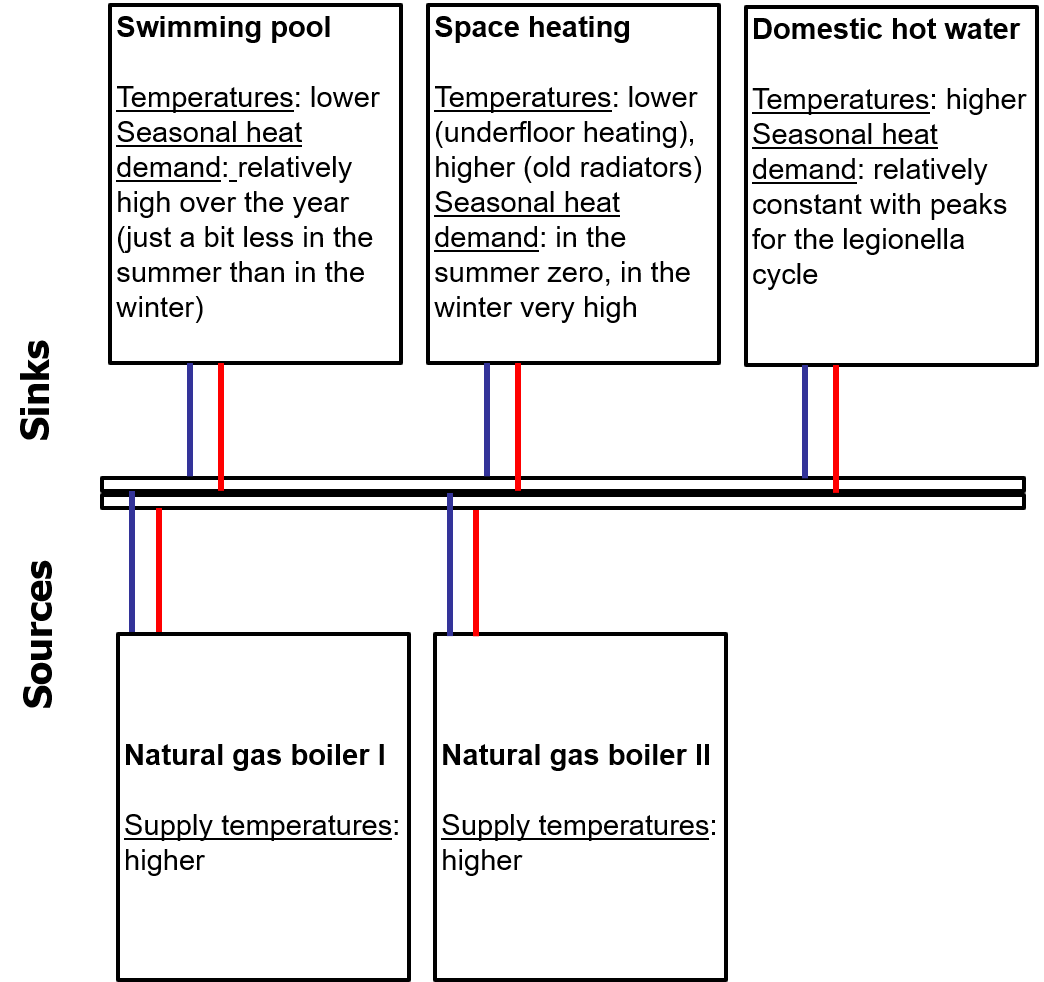
The building has relatively high annual heat demand because the swimming pool requires continuous heating throughout the year. Most of the heat for space heating is delivered through low-temperature underfloor heating, while some areas use conventional radiators. The current situation of the heating system at the swimming pool is shown in Figure 1.
The building envelope has only moderate insulation, and the facility management team has identified opportunities to improve controls and reduce ventilation losses.
Inside the swimming pool, the wastewater flow, which consists of shower water, toilet wastewater, and filter backwash water, is collected at a single point and then discharged into the sewer system. An analysis conducted by an external company found that the wastewater flow rate is sufficient to be used for heat supply in a technically and economically viable manner.
The building's roof faces primarily north, and there are no free spaces available on the swimming pool grounds.
The local electricity network has sufficient capacity to support new electrical equipment. A district heating network is not available, and there are no plans to extend one to the area in the foreseeable future. Biomass is considered unsuitable due to limited storage space and concerns about fuel deliveries.
The municipality has established the following objectives:
Task
Based on the available information, identify the most appropriate decarbonisation pathway.
Remember that the objective is not simply to replace the existing boilers but to identify the most suitable overall approach for the building.
The most appropriate approach is to combine efficiency-first measures with electrification and renewable heating.
Efficiency-first approach (Reducing Demand)
The first priority should be reducing heat demand through improved controls, optimisation of ventilation, improvement of the insulation, and practical energy efficiency measures. It should be determined whether the old radiators can be replaced with modern underfloor heating systems.
With regard to supply temperature distribution, several energy efficiency measures should be considered. First, it should be assessed whether the supply temperature can be reduced. Where this is not feasible (for example, because Legionella prevention requires temperatures of at least 60 °C) the heat generation system should be evaluated to determine whether it can be divided into separate low-temperature and high-temperature distribution systems. This approach allows each demand to be supplied at the lowest appropriate temperature, thereby minimizing energy generation losses.
Lowering the heating demand improves the performance of any future heating system and reduces operating and installation costs.
Electrification & Renewable Heating
Due to limited space and the north-facing orientation of the swimming pool rooftop, it is not practical to install a photovoltaic (PV) system or a photovoltaic-thermal (PV-T) system either on the building’s roof or in the outdoor area. A PV system could help meet the additional electricity demand generated by the heat pump. The thermal output of the PV-T system could serve as an additional source to support the heat pump.
A water-to-water heat pump using wastewater as the heat source is considered a suitable primary heating technology. Alternatively, a brine-to-water heat pump coupled with a geothermal source may also be an appropriate solution. As a next step, the geothermal potential of the site should be assessed through a borehole investigation to determine whether sufficient geothermal resources are available. An air-to-water heat pump could also be considered. However, its seasonal efficiency is generally lower than that of wastewater- or ground-source heat pumps and should therefore be evaluated carefully.
A thermal storage system could be installed to decouple heat generation from heat consumption
The available electrical capacity supports the electrification of the heating system, while the absence of a district heating network excludes that option. Biomass is not considered a suitable alternative due to the site's limited available space and operational constraints.
Because the swimming pool requires continuous heating and reliable operation throughout the year, a hybrid configuration or backup heating source may still be appropriate to provide resilience during periods of peak demand or maintenance.
This recommendation demonstrates that successful heat decarbonisation is achieved by combining pathways rather than selecting a single technology in isolation.
For this scenario, the best-fit pathway is efficiency-first combined with electrification and renewable heating because adequate electrical capacity is available, there is no access to district heating and renewable heat sources as wastewater, geothermal energy and air is available. Efficiency improvements reduce the overall heat demand, allowing the heat pump to operate more efficiently and lowering long-term operating costs. A hybrid backup system may be included to ensure reliable operation during peak heating periods.
Criteria used: