Funded by the European Union. Views and opinions expressed are however those of the author(s) only and do not necessarily reflect those of the European Union or the European Education and Culture Executive Agency. Neither the European Union nor the granting authority can be held responsible for them.
There is no universal solution. Heat decarbonisation combines multiple pathways depending on thermal loads, temperature levels, economics, infrastructure and local conditions.
Start with demand, then choose supply.
How to use the roadmap
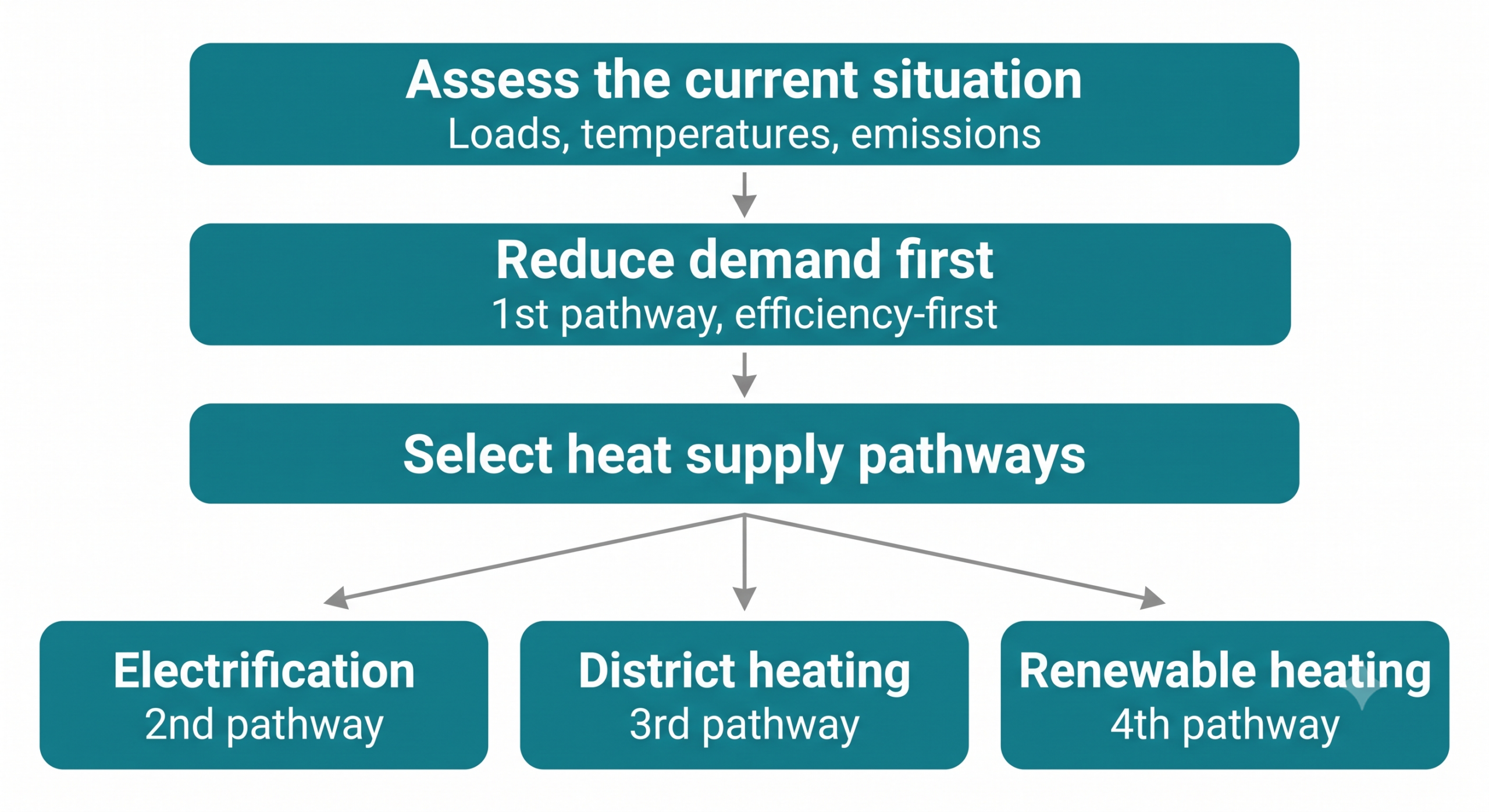
First define the system boundary and assess the incoming and outgoing energy flows, thermal loads, temperature requirements, equipment and future needs. Reduce demand through insulation, heat recovery, controls, process optimisation and lower distribution losses. Then compare suitable heat supply pathways and combinations using life-cycle cost, levelised cost of heat and sensitivity analysis. The objective is an integrated solution with low practical carbon emissions, high efficiency, reliable operation and future flexibility.
Roadmap supporting detail
There is no universal solution. Heat decarbonisation combines multiple pathways depending on thermal loads, temperature levels, economics, infrastructure and local conditions.
Shortly summarised: Start with demand, then choose supply.
Assess the current situation
Very important: Defining the system boundary and the subsystem boundaries
Incoming energy flows: Current energy consumption (if there is more than one energy source, a Sankey Diagram can help to visualise all energy sources)
Fuel used
also integrate that in the Sankey Diagram to show the efficiency factors
Outflowing energy flows
Thermal loads (temporal resolution: hourly)
Heating load curve
Cooling load curve
Required temperature levels
Existing heating equipment (also existing heating networks) and remaining asset life
Building/process characteristics
Future operational requirements
Carbon emissions
Reduce demand first (efficiency-first approach) – 1st high level pathway
Insulation
Heat recovery
In-process recycling
Use Excess process heat for heating buildings on the company location
Hydrotreated Vegetable Oil (HVO) as a last option, because it is a non-electrified supply solution.
District Heating – 3rd high level pathway
Existing District Heating
New network
Renewable Heating – 4th high level pathway
Air
Solar
Geothermal
Waste heat (also from wastewater)
Rivers or lakes
Excess process heat (not always climate-neutral)
Biomass
Economics
Compare life-cycle-cost (LCC) of different combinations of pathway solutions (inclusive: sensitivity analysis of for example changing energy price)
Compare Levelised Costs of Heating (LCoH) of different combinations of pathway solutions (inclusive: sensitivity analysis of for example changing energy price)
We use cookies to ensure that we give you the best experience on our website. If you continue to use this site we will assume that you are happy with it.