
Module 1 · Unit 4 · 8 minutes
The full narrated video will be added here. The complete transcript is available below.
Every successful clean heat project starts with good data. The quality of the final recommendation depends directly on the quality of the information that is available at the beginning of the assessment.
An important aspect is the temporal resolution of the data. Annual energy consumption can provide a general overview, but hourly or even higher-resolution data reveals how heat demand changes over time. This allows engineers to identify peak loads, operating patterns, and opportunities for improving efficiency or integrating new technologies.
Much of this information can be collected using digital tools such as energy meters, Building Management Systems (short BMS), or process monitoring systems. These systems provide detailed operational data that supports more accurate analysis and planning. Often digital data is limited, but non-digital sources such as utility bills or information from the energy provider can still provide a useful starting point. Generate new data, if possible, via measurements and valuable information from the facility manager or maintenance staff about how the heating systems work.
The key message is simple: a transition plan can only be as accurate as the data on which it is based. Better data leads to better analysis, better pathways selection, and ultimately a more successful clean heating and cooling transition.
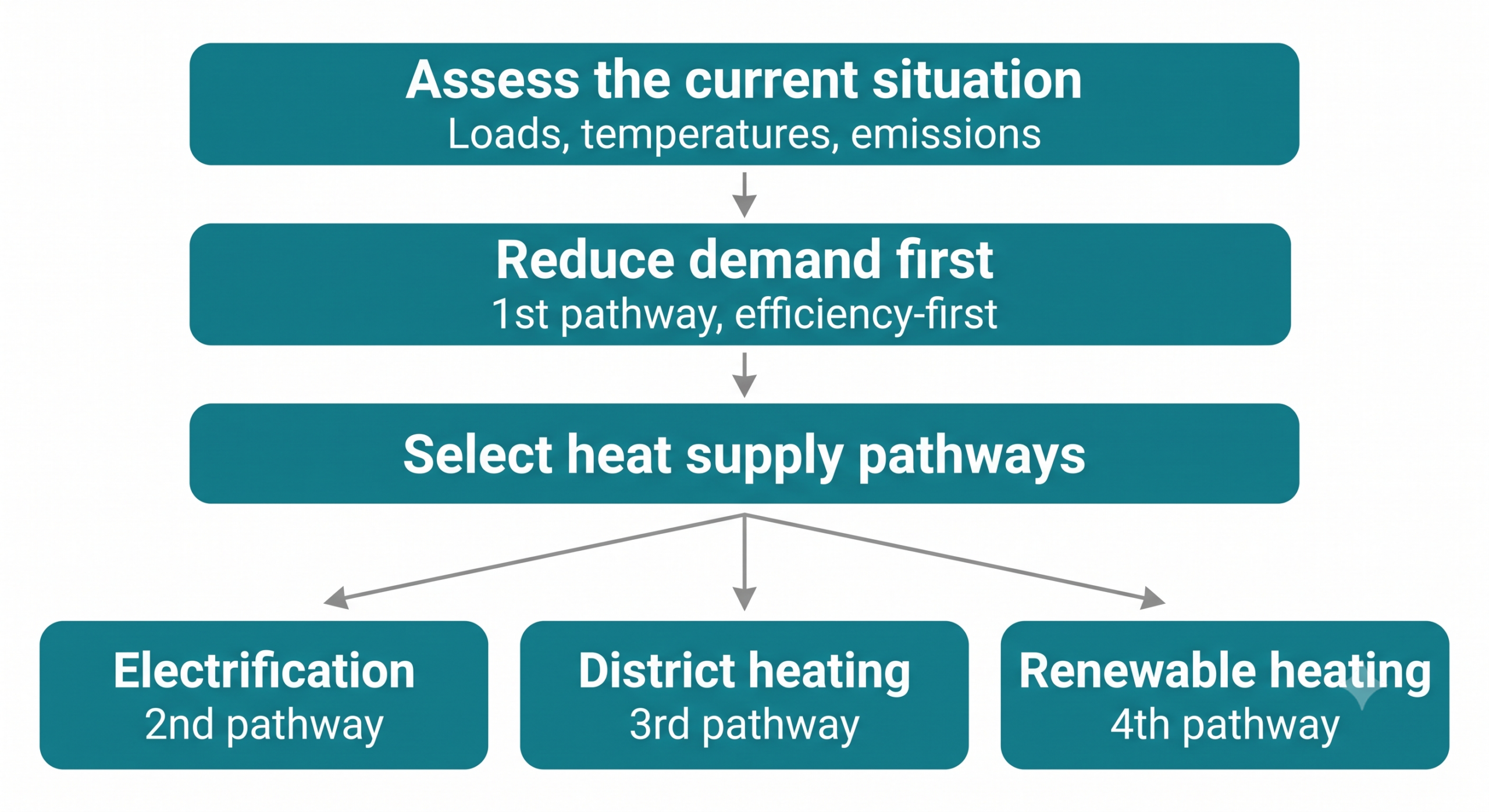
The first step is to understand the existing system.
This begins by defining the system boundary. In many facilities, multiple buildings or production processes interact with each other. Clearly defining what belongs to the assessment avoids incorrect conclusions.
Next, incoming and outgoing energy flows should be analysed. A Sankey diagram is often useful because it visualises where energy enters the system, where it is consumed, where losses occur and where energy leaves the system.
Thermal load data is particularly important. Instead of looking only at annual energy consumption, engineers should understand how heating and cooling demand changes throughout the year. Hourly heating load curves often reveal opportunities that annual totals cannot show.
Temperature requirements are equally important. Heat at 35 degrees Celsius is suitable for underfloor heating but not for many industrial processes requiring much higher temperatures.
Finally, information about existing equipment, remaining asset life, building or process characteristics, carbon emissions, future operational requirements and grid capacity completes the picture.
Before considering new heating technologies, the first priority should always be to reduce the amount of heat that is needed. This is known as the efficiency-first approach and is often the most cost-effective way to lower both energy consumption, carbon emissions and the size of the new investment.
There are several ways to reduce heat demand. Reducing the supply temperature is the most effective way. Improving insulation decreases heat losses from buildings or industrial equipment. Heat recovery systems capture thermal energy that would otherwise be wasted and reuse it elsewhere in the process or building. Improved control and automation are also measures that can increase efficiency. Process optimisation can reduce the amount of heat needed by improving production methods or operating schedules. Finally, upgrading the heat distribution system, for example by improving pipe insulation or reducing distribution losses, ensures that more of the generated heat reaches its intended destination.
By implementing these measures first, the overall heating demand is reduced. This often allows smaller heating equipment to be installed, lowers operating costs, and improves the performance of any decarbonization technology that is introduced later, such as heat pumps or district heating. For this reason, efficiency improvements should always be evaluated before selecting a new heat supply solution.
After reducing heat demand, the next step is to evaluate the available decarbonisation pathways.
The first option is electrification. Heat pumps are generally the preferred technology because they provide heat very efficiently. Hybrid systems can supply additional heat during peak demand or can supply heat on high temperature levels. Hybrid systems are particularly relevant for industrial applications. While electric resistance heating is mainly used as a backup or for the integration of sector coupling. HVO should only be considered where electrification is not technically feasible.
Another option is district heating. Existing networks can often be used directly. For new networks, planners analyse heat line density maps and use simulation tools to identify areas where district heating is technically and economically viable.
The third pathway is renewable heat. Key information is the available flow rate and temperature level of the heat source. Possible sources include ambient air, solar energy, geothermal energy, waste heat, biomass, and rivers or lakes.
After identifying the possible pathways, the next step is to compare complete solutions rather than individual technologies.
Several criteria should be considered, including technical feasibility, potential carbon reduction, reliability, future flexibility and long-term economics.
Economic performance can be evaluated using Levelised Cost of Heat and Life Cycle Cost analysis according to the VALERI Norm. VALERIE is based on the net present value method. The VALERI norm can be summarises in three key methods for evaluating energy-related investments. Every assessment must include a Net Present Value calculation and a scenario analysis, while a sensitivity analysis is strongly recommended to identify which assumptions have the greatest influence on the results. Together, these methods ensure that investment decisions are based not only on today's costs but also on future uncertainties, such as changes in energy prices, investment costs, and operating conditions. If the energy analysis revealed that there is excess heat, then selling that heat should be considered.
The best solution is the one that offers the best balance of long-term technical, environmental, and economic performance.