

Module 1 · Unit 3 · 10 minutes
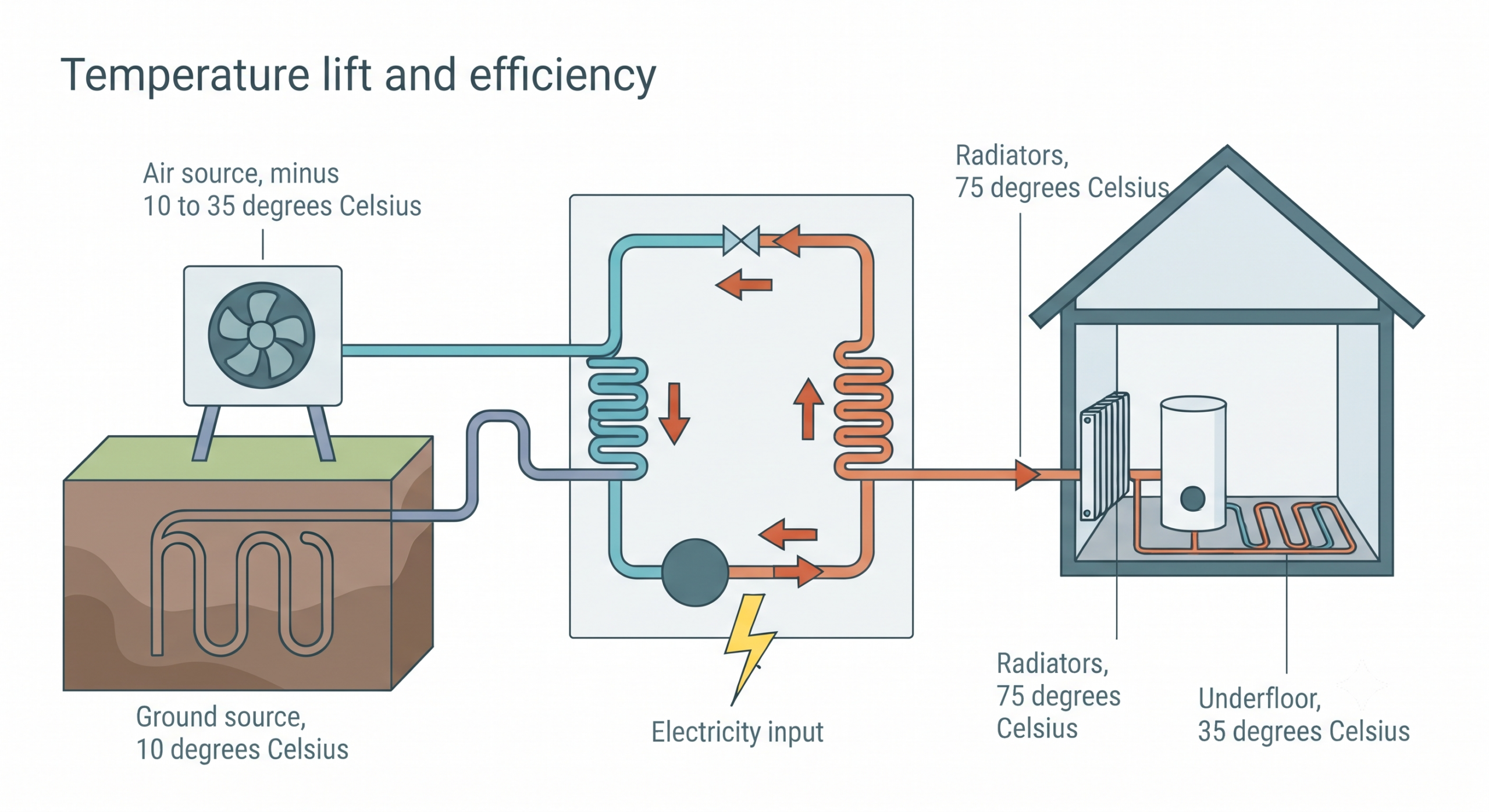
Heat pumps move heat from a lower-temperature renewable source to a higher-temperature heating system. In practice, their performance depends on several operating factors that HVAC professionals should understand when designing, sizing, and evaluating systems.
One of the most important concepts is temperature lift. Temperature lift is the difference between the temperature of the heat source (such as outdoor air or the ground) and the temperature required by the heating system. As temperature lift increases, the compressor must work harder to move heat. This increases electricity consumption and reduces efficiency. For example, a heat pump supplying 35°C water to underfloor heating (mostly installed in new buildings) will generally operate more efficiently than one supplying 75°C water to a high-temperature radiator system (mostly installed in old buildings). Efficiency can also be improved and the temperature lift reduced by using heat sources with higher and more stable temperatures throughout the year, such as the ground, instead of ambient air. If the focus is solely on efficiency rather than economic considerations, a brine-to-water heat pump that uses the ground heat would generally outperform an air-to-water heat pump. Minimizing temperature lift is therefore a key design objective for maximizing efficiency. Simplified in mathematical terms and expressed in terms of Carnot efficiency:
COP = Coefficient Of Performance (efficiency of a heat pump) (dimensionless)
η = Overall qualitiy rating (average 50 %)
Theating_system = Temperature heat distribution and storage system (in Kelvin)
Theat_source = Temperature heat source (in Kelvin)
In mathematical terms:
heating_capacity = Heating capacity, which is the capacity a heating or storage system can use (in Watt)
electrical_power = Amount of power wich the compressor needs (in Watt)
The relationship described by equations 1 and 2 can be summarised as follows: To achieve higher efficiency, the temperature spread must be reduced, which in turn increases the COP (see equation 1). For a given heating capacity, an increase in COP requires a corresponding reduction in the compressor's electrical power consumption (see formula 2). Thus, the equations mathematically demonstrate the fundamental relationship between temperature spread, performance, heating capacity, and compressor power.
Later in Module 3, you will learn in greater detail how a heat pump transfers heat and how the refrigeration cycle and its individual components (evaporator, compressor, condenser, expansion valve) operate.
Heat pumps rarely operate at full capacity throughout the year. Most of the time they run under part-load conditions, where heating demand is lower than the system's maximum output. Modern inverter-driven compressors can modulate their output to match demand more closely, improving seasonal efficiency and reducing cycling losses. Good part-load performance is important because it determines how efficiently the system operates during the majority of annual operating hours.
For air source heat pumps, defrost cycles are another practical consideration. When outdoor temperatures are around 0 °C and humidity is high, frost can accumulate on the outdoor heat exchanger. The system must periodically reverse operation to remove this frost. During defrost, heating output is temporarily reduced and overall efficiency decreases. Well-designed systems minimize defrost frequency and duration while maintaining reliable operation.
Performance should be evaluated not only through energy efficiency but also through Life Cycle Cost (LCC) analysis. LCC considers investment, operation, maintenance, replacement, and end-of-life costs over the system lifetime. The European VALERI Norm (EN 17463:2021) can be used as a framework for calculating and comparing life cycle costs. Unlike simple payback methods, the VALERI approach is based on Net Present Value (NPV) analysis, which accounts for the time value of money, expected changes in energy prices, and all costs and benefits over the full-service life of the investment.
In single-family homes, a single heating technology is usually sufficient, such as air-to-water heat pumps or brine-to-water heat pumps, which use geothermal energy as their heat source. When combined with thermal storage, this is often the most cost-effective and reliable heating technology. For large building complexes, district heating networks, or industrial heating applications, a standalone heat pump cannot reliably meet peak heating demand during very cold weather or provide the high temperatures required by processes. In these cases, a hybrid configuration adds a secondary heat source, such as a boiler or electric backup. Hybrid systems can also reduce investment costs by avoiding the need to oversize the heat pump. It is important to keep in mind that investment costs are only one part of the LCC calculation, which is why low investment costs do not often go hand in hand with a low LCC. Several common configurations are used:
Efficiency of air-to-water heat pump: ∅ 300 %
Efficiency of Hydrotreated Vegetable Oil (HVO) boiler: ∅ 90 % OR
Efficiency of biomass boiler: ∅ 80 %
Efficiency of air-to-water heat pump: ∅ 300 %
Efficiency of electric resistance heater: ∅ 100 %
Efficiency of brine-to-water heat pump: ∅ 450 %
Efficiency of HVO boiler: ∅ 90 % OR
Efficiency of biomass boiler: ∅ 80 % OR
Efficiency of electric resistance heater: ∅ 100 %
Correct sizing of hybrid systems is essential. Oversized equipment increases capital costs and may reduce operational efficiency, while undersized equipment can lead to excessive backup energy use. Accurate assessment of thermal loads is therefore fundamental. Thermal load represents the amount of heating or cooling required to maintain desired indoor or process conditions. A heat load duration curve (also called an annual duration line) sorts all hourly heating loads from highest to lowest over a year. It is a useful tool for sizing hybrid heat pump systems because it clearly separates the relatively small number of peak-load hours from the much larger number of base-load hours. A common design approach is to size the heat pump to cover 70–95 % of annual heat energy, rather than 100 %.
These technical considerations provide the foundation for selecting effective heating solutions. From this point, building decarbonisation strategies can be viewed through four high-level pathways:
Understanding heat pump operation, system sizing, costs, and environmental impacts helps professionals assess how each pathway can contribute to long-term energy and carbon reduction goals.