
Module 1 · Unit 2 · 8 minutes
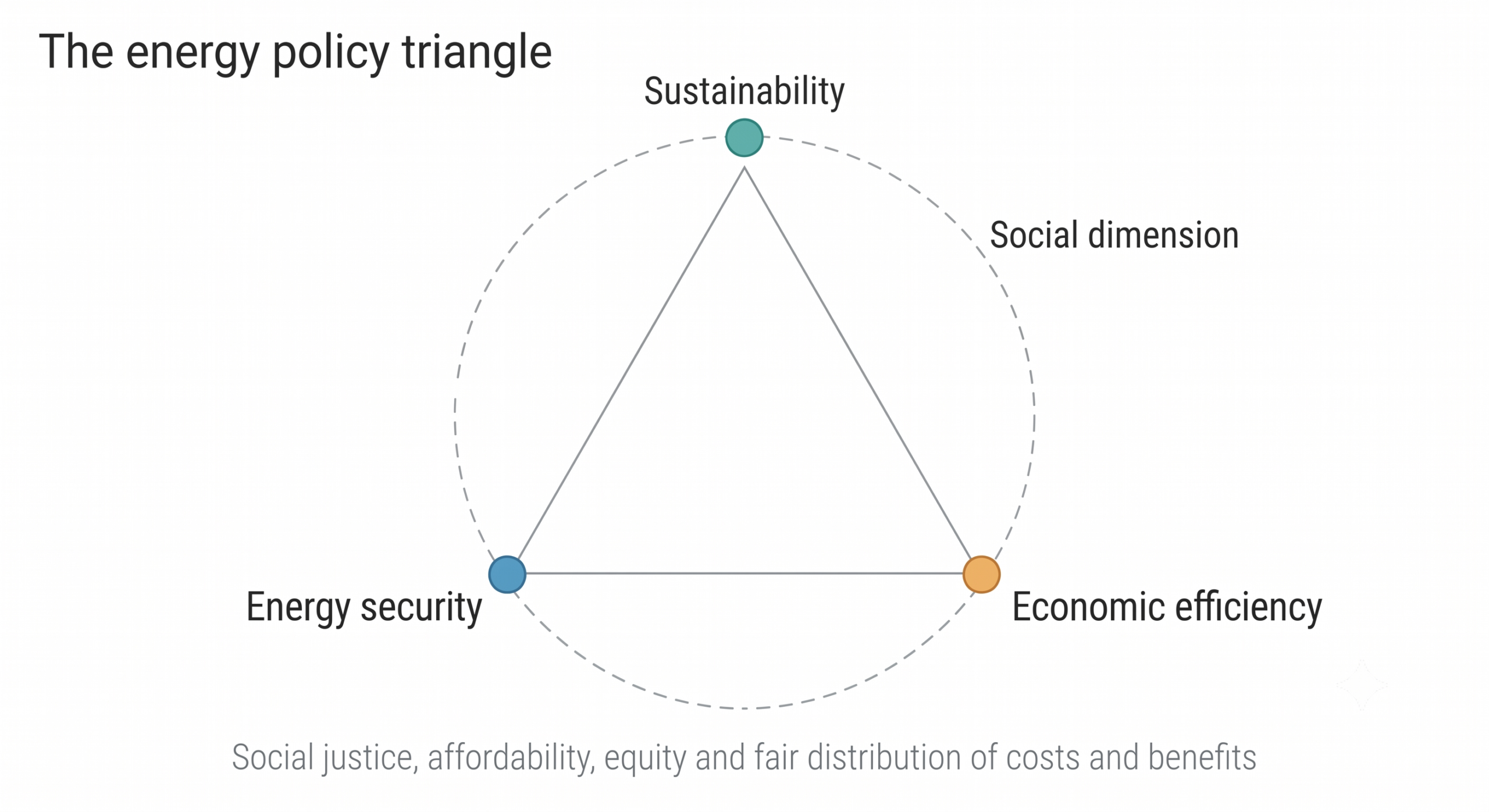
Energy policy is commonly understood through the concept of the energy policy triangle, which consists of three interconnected objectives: sustainability, energy security and economic efficiency.
Effective energy policy seeks to balance these competing goals rather than prioritizing one objective at the expense of the others. In practice, however, energy systems are also shaped by a fourth dimension: the social component. Social justice, affordability, equity, and the fair distribution of costs and benefits are inseparable from the three traditional pillars and should therefore always be considered alongside them.
This part of the unit focuses primarily on sustainability and ecological drivers. Understanding why policymakers increasingly prioritize sustainability requires first examining the greenhouse effect and its role in anthropogenic climate change.
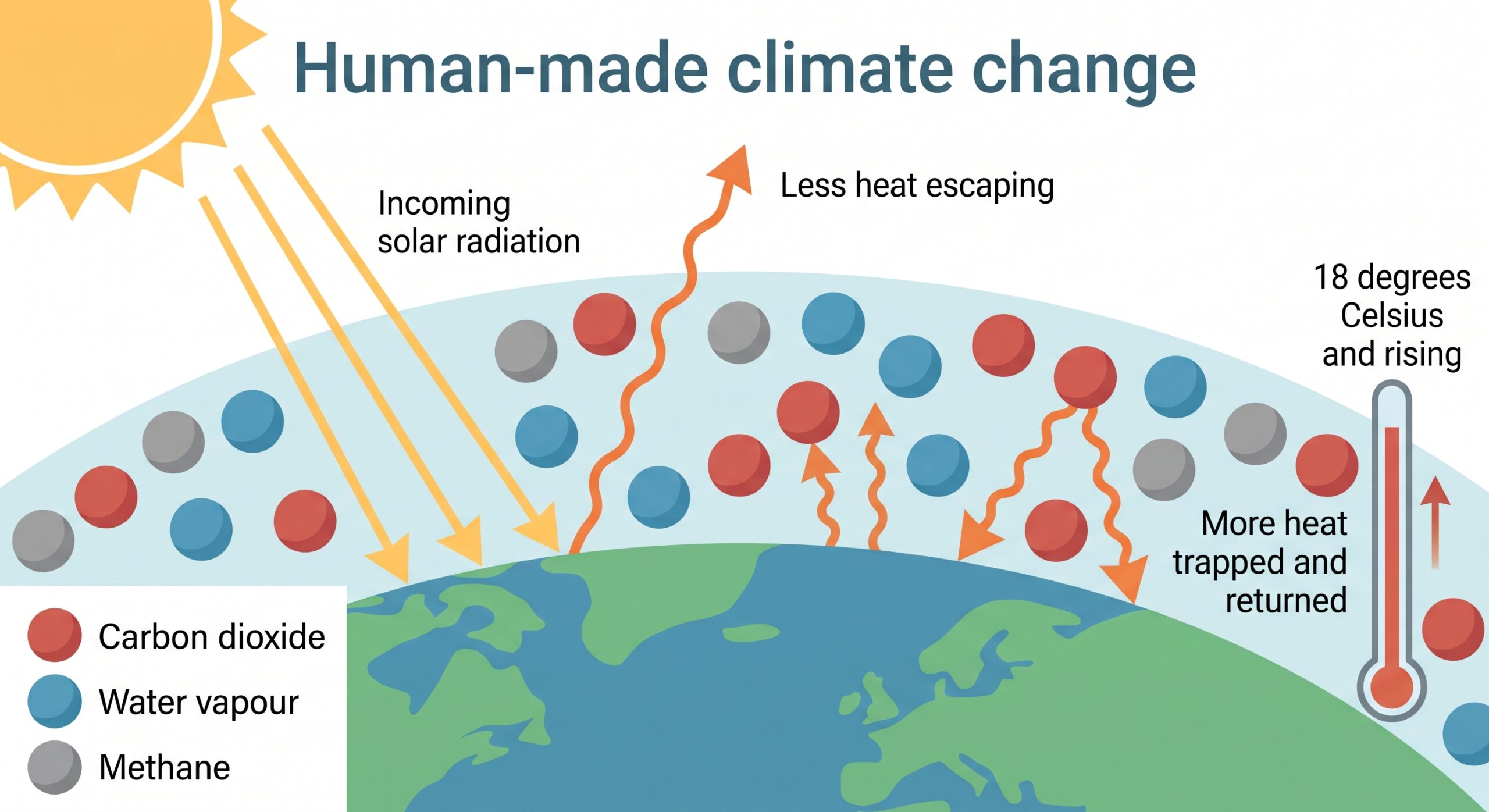
The greenhouse effect describes the process through which certain gases in Earth’s atmosphere trap heat and maintain temperatures suitable for life. Human activities have intensified this natural process by increasing atmospheric concentrations of greenhouse gases. The most important greenhouse gases include carbon dioxide, water vapor, methane, and nitrous oxide. In addition, fluorinated greenhouse gases (F-gases) contribute significantly to warming due to their exceptionally high global warming potential, short GWP, and long atmospheric lifetimes. Examples include hydrofluorocarbons (HFCs), perfluorocarbons (PFCs), and sulfur hexafluoride (SF6).
To compare the climate impact of different gases, scientists use the Global Warming Potential over a 100-year time horizon (GWP100), where carbon dioxide serves as the reference value with a GWP100 of 1. Methane has a GWP100 of approximately 30, while nitrous oxide reaches 273. Some F-gases are substantially more harmful. For example, the refrigerant difluoromethane (HFC-32), commonly used in split air-conditioning systems and heat pumps, has a GWP100 of 771. This means that releasing one kilogram of HFC-32 into the atmosphere has the 771-times warming effect of carbon dioxide.
Recognizing the significance of these emissions, the European Union introduced Regulation 2024/573 to gradually phase out HFC gases by 2050. Household split systems below 12 kW may currently still use refrigerants with a GWP below 750, but future regulations increasingly favor natural refrigerants such as carbon dioxide, propane, or ammonia, which have negligible climate impacts.
The consequences of anthropogenic climate change are no longer theoretical predictions but observable realities. Global temperatures during the period from 2011 to 2020 were approximately 1.1°C higher than during 1850–1900. Many impacts predicted decades ago are already visible today. Scientists observe declining sea ice, melting glaciers and ice sheets, rising sea levels, and increasingly frequent and intense heat waves. Ecological changes are equally evident, as plant flowering periods shift earlier and species distributions change.
Europe provides particularly clear evidence of accelerating climate impacts, as it has become the fastest-warming continent globally. The year 2024 recorded the highest temperatures both in Europe and worldwide. Severe weather events increasingly demonstrate the social and economic consequences of climate change. Flooding across Central Europe in September 2024 affected millions of people, while catastrophic floods in Valencia in October 2024 caused extensive destruction and killed 200 persons. Wildfires continue to intensify, destroying hundreds of thousands of hectares of forest.
Climate change is therefore not only a humanitarian crisis but also an economic one. Weather- and climate-related extreme events caused estimated economic losses of approximately €738 billion within the European Union between 1980 and 2023, with a significant share occurring during only the last few years. Floods, storms, and heatwaves account for the majority of these damages.
An important question remains: how much further will temperatures rise? The answer depends largely on future emissions pathways. Climate scenarios show that under very high, high and intermediate emissions pathways, warming continues well beyond 2100. Future experiences therefore depend strongly on current policy choices and societal actions.
However, climate systems also contain significant uncertainties. Climate feedback mechanisms, natural processes that either amplify or dampen climate change, play a crucial role in determining future outcomes. Positive feedback mechanisms intensify warming, whereas negative feedback mechanisms counteract it.
One example of positive feedback is water vapor feedback. As temperatures increase, atmospheric water vapor concentrations rise, further strengthening the greenhouse effect. In contrast, increased infrared radiation escaping into space represents a negative feedback because it partially offsets warming according to Stefan-Boltzmann's law. Climate scientists consider feedback mechanisms particularly important because they can transform relatively small initial temperature increases into much larger climatic changes.
Current evidence suggests that positive feedbacks are currently dominating, increasing the risk of accelerated warming. Furthermore, many feedback processes remain insufficiently understood and are not fully represented within climate models. This uncertainty implies that future warming could potentially exceed current estimates, particularly during the second half of the twenty-first century. So please keep these uncertainties in mind when we now talk about the different temperature scenarios.
According to Sixth Assessment Report from the Intergovernmental Panel on Climate Change (IPCC), current trajectories remain insufficient to achieve climate objectives. Existing policies, nationally determined contributions, and financial investments still leave considerable gaps between current emissions pathways and required reductions.
Despite these challenges, numerous technical and policy options exist and can broadly be categorized into mitigation and adaptation strategies.
Mitigation aims to reduce greenhouse gas emissions and limit future warming. Examples include expanding solar and wind energy, reducing methane emissions from fossil fuel production, increasing geothermal and hydropower deployment, carbon capture technologies, reducing food waste, improving building efficiency, promoting electric vehicles, expanding public transportation, encouraging cycling, and replacing carbon-intensive fuels.
Adaptation focuses on increasing resilience to unavoidable climate impacts. Examples include diversifying energy systems to improve reliability, strengthening power system resilience, improving agricultural management practices, supporting sustainable fisheries and aquaculture, constructing coastal protection systems, and implementing effective early warning systems for extreme weather events.
Importantly, adaptation has limits. Adaptation measures that are feasible and effective today may become increasingly constrained as temperatures continue to rise. Higher levels of warming will increase losses and damages while pushing more natural and human systems beyond their adaptive capacity. Consequently, successful adaptation requires flexible, long-term, multi-sectoral, and inclusive planning that simultaneously creates benefits across multiple sectors of society.
So, what exactly happens when the global average temperature rises by different increments above the 1850–1900 baseline? What are the consequences at 1.5, 2.0, 3.0, or 4.0 °C of warming?
It is important to note that these values refer to the global average temperature increase. Some regions are affected more severely than others. For example, the annual hottest-day temperature is projected to increase most strongly around 1.5 to 2 times more than the global average in certain mid-latitude and semi-arid regions, as well as in the South American monsoon region.
In these regions, heat and humidity risks to human health could become significant throughout the entire year (so 365 days per year) at 4.2 °C of warming. In other regions, combined temperature and humidity conditions may pose a mortality risk for “only” around 10 days per year.
But what does this mean for ecosystems? The risks and impacts vary depending on the ecosystem. Distinguishing between land-based systems and ocean/coastal ecosystems, the impacts become increasingly severe with higher levels of warming: