

Module 1 · Unit 2 · 10 minutes
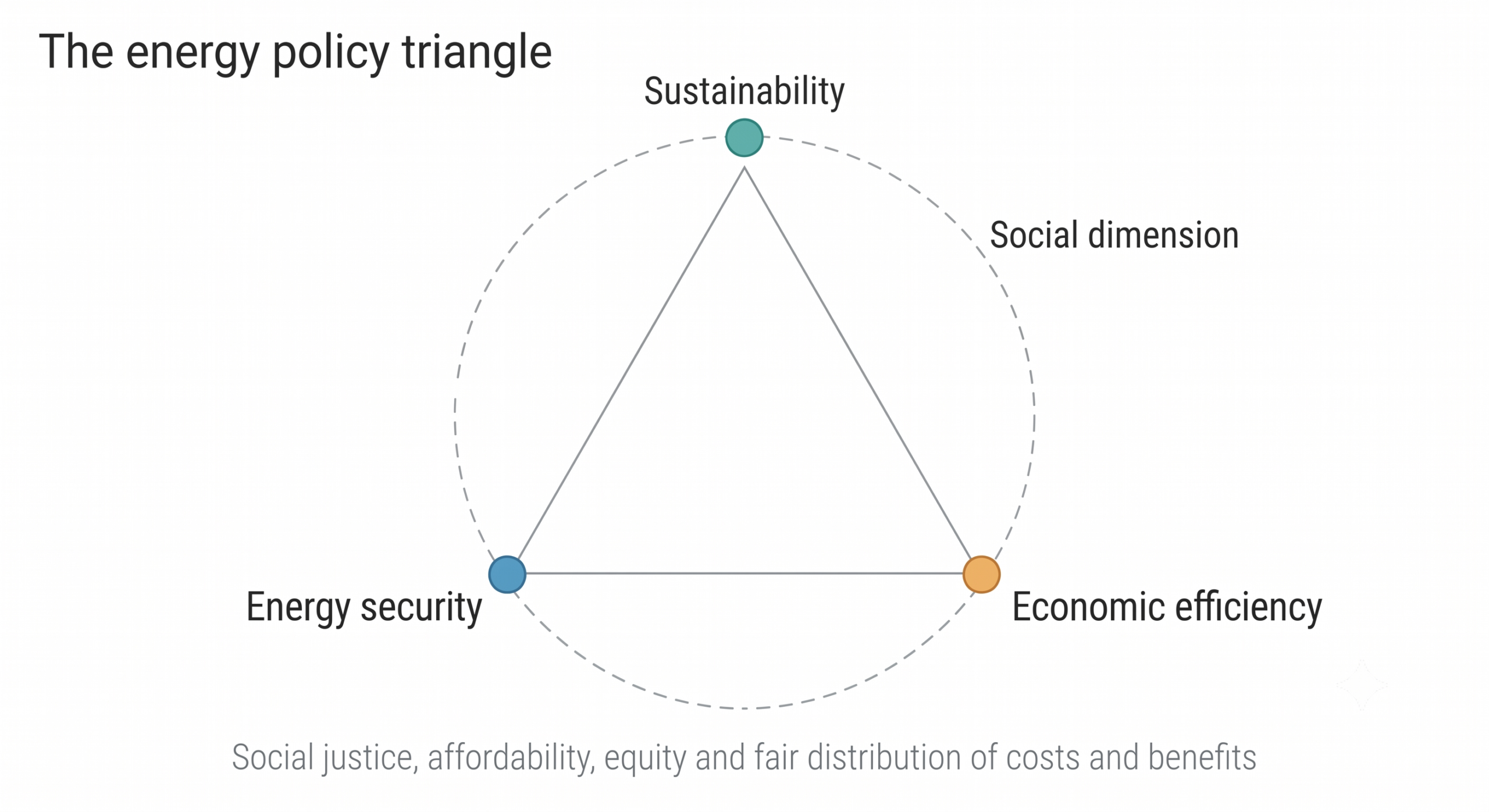
We already introduced the energy policy triangle, which consists of three interconnected objectives: sustainability, energy security, and economic efficiency.
This part of the unit focuses primarily on energy security, economic efficiency, and the social component, which can be understood as a fourth dimension. Social justice, affordability, equity, and the fair distribution of costs and benefits are inseparable from the three traditional pillars and should therefore always be considered alongside them. Understanding the clean heat and cooling transition requires recognizing that these dimensions are deeply interconnected rather than independent objectives.
Energy security is one of the central motivations for transforming heat and cooling systems. Historically, heating has been strongly dependent on fossil fuels, particularly natural gas and oil imports. In Europe, domestic fossil fuel resources are limited and declining, making many countries structurally dependent on imported energy. This dependence creates vulnerabilities that extend beyond supply disruptions and price volatility. It exposes countries to geopolitical pressure, reduces strategic autonomy, and leaves economies vulnerable to external actors and international conflicts. Recent geopolitical crises have demonstrated how reliance on imported fossil fuels can be used as a source of political leverage and economic coercion, creating significant risks for energy security and economic stability.
Increasing domestic renewable heat production through technologies such as heat pumps, district heating systems, solar thermal systems, waste heat recovery, geothermal energy, and thermal storage reduces reliance on imported fuels and strengthens resilience against external shocks. By harnessing locally available energy resources, countries can improve their energy independence, enhance long-term security of supply, and reduce exposure to unpredictable developments in global energy markets.
The transition also has important economic benefits. Large volumes of money currently leave European economies each year to pay for imported fossil fuels. Expanding domestic renewable energy and improving energy efficiency allows a greater share of energy-related spending to remain within local and national economies, supporting investment, employment, innovation, and economic growth. At the same time, reducing overall energy demand through efficiency measures further improves energy security because less energy must be generated, imported, transported, and stored.
Economic efficiency plays a critical role in enabling the Clean Heat and Cooling Transition. Although many clean heating technologies require higher upfront investments, they often provide lower operating costs and more predictable long-term expenditures. Energy efficiency acts as an additional strategic tool because reducing demand directly lowers operating costs, strengthens industrial competitiveness, and increases resilience against future price shocks.
Understanding energy prices is essential when discussing economic efficiency within clean heat transitions. On a European scale, electricity prices generally consist of several components: wholesale energy costs, network charges, taxes and levies, and supplier margins.
The wholesale component reflects market conditions and fluctuates depending on supply and demand. Electricity wholesale prices in Europe are largely determined through the merit-order principle. The European Power Exchange (EPEX SPOT), headquartered in Paris, provides a spot market for electricity volumes available for short-term delivery. In this context, “short-term” refers either to one day in advance (day-ahead) or within the current day (intraday). EPEX SPOT operates Day-Ahead auctions across 13 European countries every day.
The marginal generator needed to meet demand sets the market-clearing price. This schematic is not market-price data.
In this market structure, power plants are dispatched according to their marginal generation costs, beginning with the lowest-cost technologies and continuing until demand is satisfied. Renewable energy sources such as wind and solar typically have very low marginal costs (close to zero euro per Megawatt hour) and therefore enter the market first (lighter green color in Figure 2), followed by nuclear (darker green color in Figure 2), technologies which uses lignite as fuel (brown color in Figure 2), and various conventional generation technologies as hard coal (black), natural gas (orange) and fuel oil (red). The final power plant required to satisfy demand, the so-called marginal power plant, determines the market-clearing price for all electricity traded during that period. Since natural gas-fired power plants frequently act as marginal generators, fluctuations in fossil fuel prices, particularly gas prices, strongly influence wholesale electricity prices even when renewable generation contributes significantly to total electricity production. This explains why electricity prices during recent energy crises increased sharply despite substantial renewable deployment. As electrification of heating expands, increasing renewable generation, storage capacity, interconnections, and demand-side flexibility becomes increasingly important to reduce exposure to volatile fuel-driven price formation. Network charges, often referred to as grid or power fees, cover transmission and distribution infrastructure. These costs become increasingly important as electrification expands.
Heat prices are often structured differently depending on the heating technology. Fossil fuel heating costs are largely determined by fuel prices, making them vulnerable to international commodity markets. Electrified heating systems such as heat pumps are influenced more strongly by electricity prices and system efficiency. Since heat pumps convert electricity into heat very efficiently, fluctuations in electricity prices do not directly translate into equivalent changes in heating costs. District heating systems typically combine infrastructure costs, fuel costs, and operational costs, resulting in pricing structures that differ significantly between regions. In fifth-generation district heating and cooling (5GDHC) networks, both heating and cooling services can be provided through interconnected heat pump systems. A key characteristic of these networks is that heat extracted from buildings requiring cooling can be transferred and reused to meet heating demands elsewhere in the system. Because heating and cooling are thermodynamically linked, the simultaneous provision of both services can improve overall system efficiency and reduce operating costs. In situations where cooling demand coincides with heating demand, the additional cost of providing cooling may be relatively low, making cooling services an attractive feature for customers and a potential incentive for new consumers to connect to the 5GDHC network.
Demand-response mechanisms increasingly influence both electricity and heating economics. Implicit demand response refers to consumers adjusting consumption based on price signals, such as using electricity when prices are lower. Explicit demand response involves direct participation in flexibility markets, where consumers or aggregators receive compensation for adjusting demand when requested by grid operators. Clean heating technologies combined with thermal storage create opportunities to shift heating demand toward periods with abundant renewable electricity, lowering system costs while improving grid stability. Therefore, the clean heat transition is not only a technological transformation but also a transition toward more flexible energy systems.
The social perspective is equally important because energy systems ultimately exist to provide essential services. Affordable and stable long-term access to heating and cooling improves quality of life and protects households from energy poverty. The IPCC empathized in 2022 that energy poverty continues to affect between 8 % and 16 % of EU citizens, an estimated 35 to 72 million people, who struggle to heat or cool homes adequately. The problem is particularly severe in Southern and Eastern Europe, where even more than 20 % of households in countries such as Portugal, Bulgaria, Greece, Latvia, and Lithuania are unable to maintain adequate indoor thermal comfort. Studies indicate that lower-income households are more likely to live in poorly insulated and energy-inefficient buildings while allocating a larger proportion of their income to energy expenses. Reducing these disparities requires both the widespread availability of cost-effective renewable heating solutions and financial support mechanisms that enable vulnerable households to access them.
The consequences of failing to transform heating systems extend far beyond household energy bills. Climate inaction may intensify food shortages through crop failures, increase forced migration caused by climate disruption, worsen public health through heat stress and pollution, and place additional pressure on healthcare systems, infrastructure, and public finances. Cooling demand itself is expected to increase significantly in many regions due to rising temperatures. A successful clean heat and cooling transition therefore supports not only affordable energy access but also broader societal resilience and stability.
The political dimension connects directly with both energy security and social stability. Greater independence through domestic energy generation reduces reliance on imported fossil fuels and decreases geopolitical vulnerabilities. Countries with diversified and locally produced energy systems gain greater strategic autonomy, increased political flexibility, and stronger negotiating positions within increasingly complex geopolitical environments.
Clean heat and renewable systems also reduce supply disruption risks because decentralized systems are generally less dependent on single supply routes or imported resources. By combining renewable generation, energy efficiency, thermal storage, and flexible demand management, countries can create more resilient energy systems that are better prepared for future economic, environmental, and geopolitical uncertainties.
Ultimately, the clean heat and cooling transition demonstrates that sustainability, energy security, economic efficiency, social welfare, and political stability cannot be treated separately. Improvements in one dimension frequently reinforce progress in the others. A well-designed transition therefore not only decarbonizes heating and cooling but simultaneously strengthens resilience, affordability, competitiveness, and long-term societal stability.